

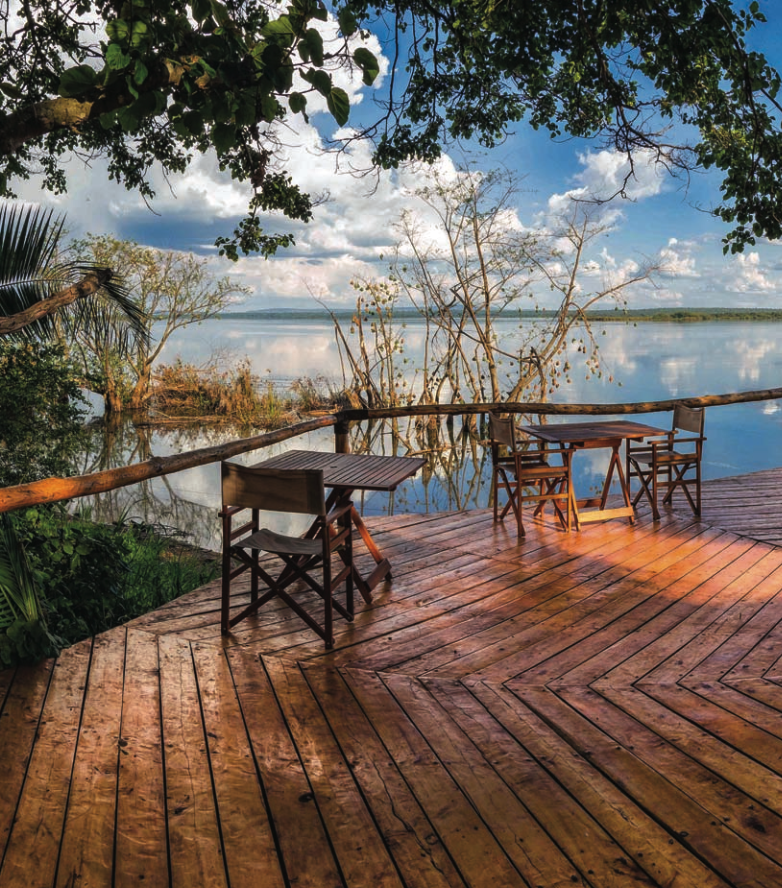
The sixth installation explores the conservation efforts led by the nonprofit African Parks. They have helped restore the landscape of the continent in part by offering a unique opportunity for wealth globetrotters who want to explore the road less traveled. At Ruzizi Tented Lodge in Rwandas Akagera National Park, there is a tree that sits in front of the wooden terrace on the shores of Lake Ihema. A thousand weaver nests hang from its branches.
In the days last light, the nests turn golden. They look like Christmas baubles, the birds hovering and darting in streaks of yellow as they nurture their homes and feed their young. It is bewitching, this business of nature, all the more so in a part of the world almost lost completely to the fallout from Rwandas 1994 genocide.
Along the Kagera River, which zigzags nearby along Rwandas border with Tanzania, refugees and soldiers lay in hiding in the bush. The animals had no protectors, while the park ceased to exist as a safe and functioning wilderness for anything to thrive. Lion, once an everyday sighting in the Seventies, had completely disappeared.
Post-genocide, Akagera was halved in size, reduced from 2,700 square kilometers, to 1,120 square kilometers to make room for returning refugees. Yet there was still plenty worth saving. Akagera is Rwandas only savannah park, with rolling hills of acacia bush, scattered grasslands and riverine forests. Akagera is also home to Central Africas largest protected wetland, which accounts for the extraordinarily rich birdlife.
In 2009, this potential was recognized by African Parks, a South Africanbased nonprofit currently managing some 5.9 million hectares in seven African countries on behalf of national governments, from Zambia to the Democratic Republic of the Congo. Each territory AP is involved with has different issues; all are under threatcritical ecosystems under pressure from conflict or the pan-African poaching scourge. When we took on Akagera, it was a deeply neglected part of Rwanda, says park manager Jes Gruner. It took us five years to restructure and get the law-enforcement teams to function effectively.
Akagera is one of APs early turnaround parks an area gone to the dogs and now dramatically rehabilitated to such an extent that it is attracting tourists in record numbers. The park, now partly fenced to assist in the protection of Rwandas mega-fauna, has increased its visitor numbers from 12,000 in 2009 to 27,980 in 2014 and generated just over $1 million in park revenue. And while a 20 percent sample wildlife count put animal numbers in the area at 2,000 in 2010, by 2013thanks to the efforts of African Parksnumbers had quadrupled.
To accommodate the run of visitors looking to experience the bounty of nature at the park, Ruzizi Tented Lodge a popular little camp -- opened in 2013, bringing in a new generation of safari client, both Rwandan and international. Akagera is now easily worth a three-night stay after visiting the iconic mountain gorillas in Rwandas other great wildlife area, Virunga National Park. AP has pulled off this success story not just through a combination of military-style anti-poaching training and strategic investments in security fencing, but also through the commitment of its staff.
AP is an organization that acts with boots on the ground, says Ronald Ulrich, a former managing director at Morgan Stanley and current chairman of African Parks Foundation America. The NGOs ability to get things done is why AP is championed by the likes of South Africanborn private safari guide Michael Lorentz, who heads up Passage to Africa (passagetoafrica.com). This is the company with whom I travel to Rwanda.
Lorentz leads high-end tours all over the continent. While most of his trips are for wealthy Americans staying en famille in Africas smartest lodges, a few excursionsand these are the safaris most precious to himaccess the frontier territory with which AP is involved. Its these safaris that allow Lorentz to convert his powerful client base from wealthy tourist to potential donor for APs conservation agenda. This syncs with a wider trend: AP receives significant funding at institutional levels, including from the European Union, but is also riding a wave of private philanthropic support to protect the African wilderness.
AP works on a deeply impressive scale, says Will Jones, founder of Wild Philanthropy (wild philanthropy.com). This a new organization that connects conservation projects in Africa with wealthy travelers who have the cash and will to dig deep and bring about change. They find the means to make conservation game plans happen by collaborating with national governments rather than working in isolation.
In January, I visit Zakouma National Park, a park in southeast Chad that AP has managed since 2010, this time traveling with another safari operator, Steppes Travel (steppestravel.com). As an industry, I think we need to push harder for that conversion from traveler to donor, says Justin Wateridge, managing director at Steppes. Does it work? Occasionally, yes. But it needs to be even more effective if travel companies like ours are to help conserve the assets we make our living from in Africa.
In Zakouma, APs existing network of supporters have donated significantlyplanes, schools, brick machines, money to build Zakoumas new luxury mobile campwhich has also helped bring this former poaching hotspot back under control. Zakoumas elephant herdsdecimated in recent years by the janjaweed militia, who would ride in with machine guns from neighboring Sudanare finally growing again, protected by APs hard-core team of impeccably trained anti-poaching wardens, in a highly managed system utilizing planes, motorbikes and horses.
The result of APs presence in Chad after just five years of workassisted by a 7.7million-euro commitment in 2011 from the EUis a park safe enough to visit, staying either in the $100-a-night, government-built Tinga Camp or in the newer, mobile safari camp, Camp Nomade, where I stayed. In these elegant environs, its hard to imagine the horror that has come before, as we settle in to sun- down beside silver rivers of water, where flocks of whistling ducks come to drink. We watched Kordofan giraffe wander among the acacia.
We listened to the cry of hyena at night. We went on safari with elephants in herds 400 animals strong. I think of the American photographer Ansel Adams and his description of what this all means: how wilderness, or wildness, is a mystique, a religion, an intense philosophy, a dream of ideal society, phenomena of an advanced society and a unique contribution to the democratic idea.Click here to see the full issue.
For more information on African Parks and its other projects in Zambia, Central African Republic, Malawi and the Congo, visit africanparks.org. For donor inquiries, email Nicole Mollo at nicolem@ african-parks.org.


Spring 2015s edition of ONE Life magazine shines a light on world trends, culture and design as the award-winning, proprietary lifestyle publication of ONE Sothebys InternationalRealty. Were blogging the unique content available in this exclusive publication. The sixth installation explores the conservation efforts led by the nonprofit African Parks. They have helped restore the landscape of the continent in part by offering a unique opportunity for wealth globetrotters who want to explore the road less traveled.
At Ruzizi Tented Lodge in Rwandas Akagera National Park, there is a tree that sits in front of the wooden terrace on the shores of Lake Ihema. A thousand weaver nests hang from its branches. In the days last light, the nests turn golden. They look like Christmas baubles, the birds hovering and darting in streaks of yellow as they nurture their homes and feed their young.
It is bewitching, this business of nature, all the more so in a part of the world almost lost completely to the fallout from Rwandas 1994 genocide. Along the Kagera River, which zigzags nearby along Rwandas border with Tanzania, refugees and soldiers lay in hiding in the bush. The animals had no protectors, while the park ceased to exist as a safe and functioning wilderness for anything to thrive. Lion, once an everyday sighting in the Seventies, had completely disappeared.
Post-genocide, Akagera was halved in size, reduced from 2,700 square kilometers, to 1,120 square kilometers to make room for returning refugees. Yet there was still plenty worth saving. Akagera is Rwandas only savannah park, with rolling hills of acacia bush, scattered grasslands and riverine forests. Akagera is also home to Central Africas largest protected wetland, which accounts for the extraordinarily rich birdlife.
In 2009, this potential was recognized by African Parks, a South Africanbased nonprofit currently managing some 5.9 million hectares in seven African countries on behalf of national governments, from Zambia to the Democratic Republic of the Congo. Each territory AP is involved with has different issues; all are under threatcritical ecosystems under pressure from conflict or the pan-African poaching scourge.
When we took on Akagera, it was a deeply neglected part of Rwanda, says park manager Jes Gruner. It took us five years to restructure and get the law-enforcement teams to function effectively.
Akagera is one of APs early turnaround parks an area gone to the dogs and now dramatically rehabilitated to such an extent that it is attracting tourists in record numbers. The park, now partly fenced to assist in the protection of Rwandas mega-fauna, has increased its visitor numbers from 12,000 in 2009 to 27,980 in 2014 and generated just over $1 million in park revenue. And while a 20 percent sample wildlife count put animal numbers in the area at 2,000 in 2010, by 2013thanks to the efforts of African Parksnumbers had quadrupled.
To accommodate the run of visitors looking to experience the bounty of nature at the park, Ruzizi Tented Lodge a popular little camp -- opened in 2013, bringing in a new generation of safari client, both Rwandan and international. Akagera is now easily worth a three-night stay after visiting the iconic mountain gorillas in Rwandas other great wildlife area, Virunga National Park.
AP has pulled off this success story not just through a combination of military-style anti-poaching training and strategic investments in security fencing, but also through the commitment of its staff. AP is an organization that acts with boots on the ground, says Ronald Ulrich, a former managing director at Morgan Stanley and current chairman of African Parks Foundation America. The NGOs ability to get things done is why AP is championed by the likes of South Africanborn private safari guide Michael Lorentz, who heads up Passage to Africa (passagetoafrica.com). This is the company with whom I travel to Rwanda.
Lorentz leads high-end tours all over the continent. While most of his trips are for wealthy Americans staying en famille in Africas smartest lodges, a few excursionsand these are the safaris most precious to himaccess the frontier territory with which AP is involved. Its these safaris that allow Lorentz to convert his powerful client base from wealthy tourist to potential donor for APs conservation agenda. This syncs with a wider trend: AP receives significant funding at institutional levels, including from the European Union, but is also riding a wave of private philanthropic support to protect the African wilderness.
AP works on a deeply impressive scale, says Will Jones, founder of Wild Philanthropy (wild philanthropy.com), a new organization that connects conservation projects in Africa with wealthy travelers who have the cash and will to dig deep and bring about change. They find the means to make conservation game plans happen by collaborating with national governments rather than working in isolation.
In January, I visit Zakouma National Park, a park in southeast Chad that AP has managed since 2010, this time traveling with another safari operator, Steppes Travel (steppestravel.com). As an industry, I think we need to push harder for that conversion from traveler to donor, says Justin Wateridge, managing director at Steppes. Does it work? Occasionally, yes. But it needs to be even more effective if travel companies like ours are to help conserve the assets we make our living from in Africa.
In Zakouma, APs existing network of supporters have donated significantlyplanes, schools, brick machines, money to build Zakoumas new luxury mobile campwhich has also helped bring this former poaching hotspot back under control. Zakoumas elephant herdsdecimated in recent years by the janjaweed militia, who would ride in with machine guns from neighboring Sudanare finally growing again, protected by APs hard-core team of impeccably trained anti-poaching wardens, in a highly managed system utilizing planes, motorbikes and horses.
The result of APs presence in Chad after just five years of workassisted by a 7.7million-euro commitment in 2011 from the EUis a park safe enough to visit, staying either in the $100-a-night, government-built Tinga Camp or in the newer, mobile safari camp, Camp Nomade, where I stay.
In these elegant environs, its hard to imagine the horror that has come before, as we settle in to sun- down beside silver rivers of water, where flocks of whistling ducks come to drink.
We watch Kordofan giraffe wander among the acacia. e listen to the cry of hyena at night. We go on safari with elephants in herds 400 animals strong. I think of the American photographer Ansel Adams and his description of what this all means: how wilderness, or wildness, is a mystique, a religion, an intense philosophy, a dream of ideal society, phenomena of an advanced society and a unique contribution to the democratic idea.
For more information on African Parks and its other projects in Zambia, Central African Republic, Malawi and the Congo, visit africanparks.org. For donor inquiries, email Nicole Mollo at nicolem@ african-parks.org.
Click here to see the full issue.
To subscribe to ONE LIFE Magazine click here.
Spring 2015s edition of ONE Life magazine shines a light on world trends, culture and design as the award-winning, proprietary lifestyle publication of ONE Sothebys International Realty. Were blogging the unique content available in this exclusive publication. The sixth installation explores the conservation efforts led by the nonprofit African Parks. They have helped restore the landscape of the continent in part by offering a unique opportunity for wealth globetrotters who want to explore the road less traveled.
At Ruzizi Tented Lodge in Rwandas Akagera National Park, there is a tree that sits in front of the wooden terrace on the shores of Lake Ihema. A thousand weaver nests hang from its branches. In the days last light, the nests turn golden. They look like Christmas baubles, the birds hovering and darting in streaks of yellow as they nurture their homes and feed their young.
It is bewitching, this business of nature, all the more so in a part of the world almost lost completely to the fallout from Rwandas 1994 genocide. Along the Kagera River, which zigzags nearby along Rwandas border with Tanzania, refugees and soldiers lay in hiding in the bush. The animals had no protectors, while the park ceased to exist as a safe and functioning wilderness for anything to thrive. Lion, once an everyday sighting in the Seventies, had completely disappeared.
Post-genocide, Akagera was halved in size, reduced from 2,700 square kilometers, to 1,120 square kilometers to make room for returning refugees. Yet there was still plenty worth saving. Akagera is Rwandas only savannah park, with rolling hills of acacia bush, scattered grasslands and riverine forests. Akagera is also home to Central Africas largest protected wetland, which accounts for the extraordinarily rich birdlife.
In 2009, this potential was recognized by African Parks, a South Africanbased nonprofit currently managing some 5.9 million hectares in seven African countries on behalf of national governments, from Zambia to the Democratic Republic of the Congo. Each territory AP is involved with has different issues; all are under threatcritical ecosystems under pressure from conflict or the pan-African poaching scourge.
When we took on Akagera, it was a deeply neglected part of Rwanda, says park manager Jes Gruner. It took us five years to restructure and get the law-enforcement teams to function effectively.
Akagera is one of APs early turnaround parks an area gone to the dogs and now dramatically rehabilitated to such an extent that it is attracting tourists in record numbers. The park, now partly fenced to assist in the protection of Rwandas mega-fauna, has increased its visitor numbers from 12,000 in 2009 to 27,980 in 2014 and generated just over $1 million in park revenue. And while a 20 percent sample wildlife count put animal numbers in the area at 2,000 in 2010, by 2013thanks to the efforts of African Parksnumbers had quadrupled.
To accommodate the run of visitors looking to experience the bounty of nature at the park, Ruzizi Tented Lodge a popular little camp -- opened in 2013, bringing in a new generation of safari client, both Rwandan and international. Akagera is now easily worth a three-night stay after visiting the iconic mountain gorillas in Rwandas other great wildlife area, Virunga National Park.
AP has pulled off this success story not just through a combination of military-style anti-poaching training and strategic investments in security fencing, but also through the commitment of its staff. AP is an organization that acts with boots on the ground, says Ronald Ulrich, a former managing director at Morgan Stanley and current chairman of African Parks Foundation America. The NGOs ability to get things done is why AP is championed by the likes of South Africanborn private safari guide Michael Lorentz, who heads up Passage to Africa (passagetoafrica.com). This is the company with whom I travel to Rwanda.
Lorentz leads high-end tours all over the continent. While most of his trips are for wealthy Americans staying en famille in Africas smartest lodges, a few excursionsand these are the safaris most precious to himaccess the frontier territory with which AP is involved. Its these safaris that allow Lorentz to convert his powerful client base from wealthy tourist to potential donor for APs conservation agenda. This syncs with a wider trend: AP receives significant funding at institutional levels, including from the European Union, but is also riding a wave of private philanthropic support to protect the African wilderness.
AP works on a deeply impressive scale, says Will Jones, founder of Wild Philanthropy (wild philanthropy.com), a new organization that connects conservation projects in Africa with wealthy travelers who have the cash and will to dig deep and bring about change. They find the means to make conservation game plans happen by collaborating with national governments rather than working in isolation.
In January, I visit Zakouma National Park, a park in southeast Chad that AP has managed since 2010, this time traveling with another safari operator, Steppes Travel (steppestravel.com). As an industry, I think we need to push harder for that conversion from traveler to donor, says Justin Wateridge, managing director at Steppes. Does it work? Occasionally, yes. But it needs to be even more effective if travel companies like ours are to help conserve the assets we make our living from in Africa.
In Zakouma, APs existing network of supporters have donated significantlyplanes, schools, brick machines, money to build Zakoumas new luxury mobile campwhich has also helped bring this former poaching hotspot back under control. Zakoumas elephant herdsdecimated in recent years by the janjaweed militia, who would ride in with machine guns from neighboring Sudanare finally growing again, protected by APs hard-core team of impeccably traind anti-poaching wardens, in a highly managed system utilizing planes, motorbikes and horses.
The result of APs presence in Chad after just five years of workassisted by a 7.7million-euro commitment in 2011 from the EUis a park safe enough to visit, staying either in the $100-a-night, government-built Tinga Camp or in the newer, mobile safari camp, Camp Nomade, where I stay.
In these elegant environs, its hard to imagine the horror that has come before, as we settle in to sun- down beside silver rivers of water, where flocks of whistling ducks come to drink.
We watch Kordofan giraffe wander among the acacia. We listen to the cry of hyena at night. We go on safari with elephants in herds 400 animals strong. I think of the American photographer Ansel Adams and his description of what this all means: how wilderness, or wildness, is a mystique, a religion, an intense philosophy, a dream of ideal society, phenomena of an advanced society and a unique contribution to the democratic idea.
For more information on African Parks and its other projects in Zambia, Central African Republic, Malawi and the Congo, visit africanparks.org. For donor inquiries, email Nicole Mollo at nicolem@ african-parks.org.
Click here to see the full issue.
To subscribe to ONE LIFE Magazine click here.
Spring 2015s edition of ONE Life magazine shines a light on world trends, culture and design as the award-winning, proprietary lifestyle publication of ONE Sothebys International Realty. Were blogging the unique content available in this exclusive publication. The sixth installation explores the conservation efforts led by the nonprofit African Parks. They have helped restore the landscape of the continent in part by offering a unique opportunity for wealth globetrotters who want to explore the road less traveled.
At Ruzizi Tented Lodge in Rwandas Akagera National Park, there is a tree that sits in front of the wooden terrace on the shores of Lake Ihema. A thousand weaver nests hang from its branches. In the days last light, the nests turn golden. They look like Christmas baubles, the birds hovering and darting in streaks of yellow as they nurture their homes and feed their young.
It is bewitching, this business of nature, all the more so in a part of the world almost lost completely to the fallout from Rwandas 1994 genocide. Along the Kagera River, which zigzags nearby along Rwandas border with Tanzania, refugees and soldiers lay in hiding in the bush. The animals had no protectors, while the park ceased to exist as a safe and functioning wilderness for anything to thrive. Lion, once an everyday sighting in the Seventies, had completely disappeared.
Post-genocide, Akagera was halved in size, reduced from 2,700 square kilometers, to 1,120 square kilometers to make room for returning refugees. Yet there was still plenty worth saving. Akagera is Rwandas only savannah park, with rolling hills of acacia bush, scattered grasslands and riverine forests. Akagera is also home to Central Africas largest protected wetland, which accounts for the extraordinarily rich birdlife.
In 2009, this potential was recognized by African Parks, a South Africanbased nonprofit currently managing some 5.9 million hectares in seven African countries on behalf of national governments, from Zambia to the Democratic Republic of the Congo. Each territory AP is involved with has different issues; all are under threatcritical ecosystems under pressure from conflict or the pan-African poaching scourge.
When we took on Akagera, it was a deeply neglected part of Rwanda, says park manager Jes Gruner. It took us five years to restructure and get the law-enforcement teams to function effectively.
Akagera is one of APs early turnaround parks an area gone to the dogs and now dramatically rehabilitated to such an extent that it is attracting tourists in record numbers. The park, now partly fenced to assist in the protection of Rwandas mega-fauna, has increased its visitor numbers from 12,000 in 2009 to 27,980 in 2014 and generated just over $1 million in park revenue. And while a 20 percent sample wildlife count put animal numbers in the area at 2,000 in 2010, by 2013thanks to the efforts of African Parksnumbers had quadrupled.
To accommodate the run of visitors looking to experience the bounty of nature at the park, Ruzizi Tented Lodge a popular little camp -- opened in 2013, bringing in a new generation of safari client, both Rwandan and international. Akagera is now easily worth a three-night stay after visiting the iconic mountain gorillas in Rwandas other great wildlife area, Virunga National Park.
AP has pulled off this success story not just through a combination of military-style anti-poaching training and strategic investments in security fencing, but also through the commitment of its staff. AP is an organization that acts with boots on the ground, says Ronald Ulrich, a former managing director at Morgan Stanley and current chairman of African Parks Foundation America. The NGOs ability to get things done is why AP is championed by the likes of South Africanborn private safari guide Michael Lorentz, who heads up Passage to Africa (passagetoafrica.com). This is the company with whom I travel to Rwanda.
Lorentz leads high-end tours all over the continent. While most of his trips are for wealthy Americans staying en famille in Africas smartest lodges, a few excursionsand these are the safaris most precious to himaccess the frontier territory with which AP is involved. Its these safaris that allow Lorentz to convert his powerful client base from wealthy tourist to potential donor for APs conservation agenda. This syncs with a wider trend: AP receives significant funding at institutional levels, including from the European Union, but is also riding a wave of private philanthropic support to protect the African wilderness.
AP works on a deeply impressive scale, says Will Jones, founder of Wild Philanthropy (wild philanthropy.com), a new organization that connects conservation projects in Africa with wealthy travelers who have the cash and will to dig deep and bring about change. They find the means to make conservation game plans happen by collaborating with national governments rather than working in isolation.
In January, I visit Zakouma National Park, a park in southeast Chad that AP has managed since 2010, this time traveling with another safari operator, Steppes Travel (steppestravel.com). As an industry, I think we need to push harder for that conversion from traveler to donor, says Justin Wateridge, managing director at Steppes. Does it work? Occasionally, yes. But it needs to be even more effective if travel companies like ours are to help conserve the assets we make our living from in Africa.
In Zakouma, APs existing network of supporters have donated significantlyplanes, schools, brick machines, money to build Zakoumas new luxury mobile campwhich has also helped bring this former poaching hotspot back under control. Zakoumas elephant herdsdecimated in recent years by the janjaweed militia, who would ride in with machine guns from neighboring Sudanare finally growing again, protected by APs hard-core team of impeccably trained anti-poaching wardens, in a highly managed system utilizing planes, motorbikes and horses.
The result of APs presence in Chad after just five years of workassisted by a 7.7million-euro commitment in 2011 from the EUis a park safe enough to visit, staying either in the $100-a-night, government-built Tinga Camp or in the newer, mobile safari camp, Camp Nomade, where I stay.
In these elegant environs, its hard to imagine the horror that has come before, as we settle in to sun- down beside silver rivers of water, where flocks of whistling ducks come to drink.
We watch Kordofan giraffe wander among the acacia. We listen to the cry of hyena at night. We go on safari with elephants in herds 400 animals strong. I think of the American photographer Ansel Adams and his description of what this all means: how wilderness, or wildness, is a mystique, a religion, an intense philosophy, a dream of ideal society, phenomena of an advanced society and a unique contribution to the democratic idea.
For more information on African Parks and its other projects in Zambia, Central African Republic, Malawi and the Congo, visit africanparks.org. For donor inquiries, email Nicole Mollo at nicolem@ african-parks.org.
Click here to see the full issue.
To subscribe to ONE LIFE Magazine click here.

Socials