

With the launch of the latest issue, were blogging the unique content available in this exclusive publication. This week were continuing to share the latest in culture and art in the Artist to Watch subsection. Ren Francisco is reinventing the very concept of art, on a global scale. He has started a transformation of the environment around him, bringing art to the community in a practical way.
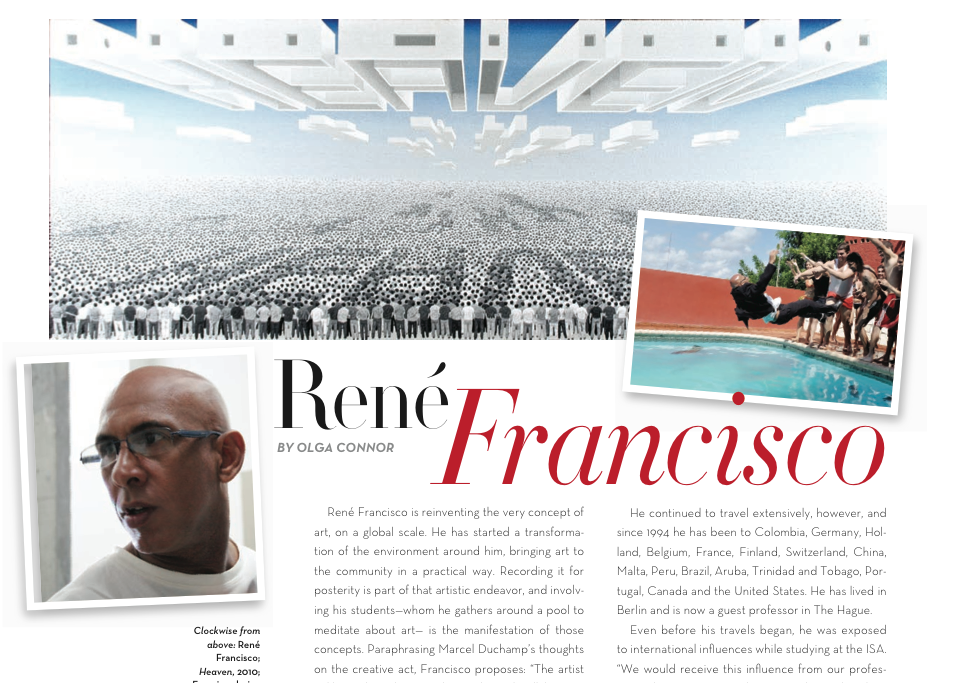
Recording it for posterity is part of that artistic endeavor, and involving his studentswhom he gathers around a pool to meditate about art is the manifestation of those concepts. Paraphrasing Marcel Duchamps thoughts on the creative act, Francisco proposes: The artist is like a sharpshooter who works and collaborates secretly with culture. Francisco is far from isolated in his artistic endeavors.
The Cuban artist is well rooted in his community, butthrough his studies at the Instituto Superior de Arte (ISA) in Havana and his travels around the worldhe has developed international relations and vital access to European advances in his field. In 1990, Francisco left his homeland for the first time to visit Spain. It was the moment in which a great part of the artists of my generation left for other countries, says Francisco. I lived in Spain for eight months and another nine months in Mexico [City].
But he returned to Cuba, in spite of the fact that locals were living through a difficult period on the island at that time. He continued to travel extensively, however, and since 1994 he has been to Colombia, Germany, Holland, Belgium, France, Finland, Switzerland, China, Malta, Peru, Brazil, Aruba, Trinidad and Tobago, Portugal, Canada and the United States. He has lived in Berlin and is now a guest professor in The Hague.
Even before his travels began, he was exposed to international influences while studying at the ISA. We would receive this influence from our professors, who were vanguard artists and were breaking the wall that made it impossible to get contemporary informationliterary as well as visualabout what was happening outside of the Cuban context in the previous 20 years, recalls Francisco. These teachings were supposedly forbidden, but this was the glasnost and perestroika period at the end of the 1980s in the Soviet Union, which influenced intellectual thinking in Cuba.
Upon returning from their limited travel, those professors would bring us books by Joseph Kosuth, Sol Le Wit, Umberto Eco, Michel Foucault and other contemporary thinkers, rare or prohibited in the island, and numerous magazines such as Art News, Art in America and Art Forum, says Francisco. In 1985, while still studying at the ISA, Francisco began teaching Alexandre Arrechea and Dagoberto Rodrguez in his drawing classes at Cubas Escuela Nacional de Artes. They would later advance to the ISA and join him in his studies there, which became an important encounter in his career.
At that time, I was beginning to understand pedagogy as a work tool for doing art in the open air, trying to break the limits between one discipline and another, Francisco explains. It was precisely with those students that I started working on that concept. I believe Dagoberto and Alexandre were the ones who named this experimental project Through a Pragmatic Pedagogy [Desde una Pragmtica Pedaggica]. This united us during the school year as a working collective. Later on, they became Los Carpinteros [The Carpenters], together with Marco Castillo, and I have always maintained with them a curious relationship.
Los Carpinteros believe in working collectively, like the members of an old-fashioned guild but with a sophisticated, modern approach. The idea is that greater art can be achieved through student- professor interaction. Francisco visited barrios in deer straits in Havana, El Romerillo and Buenavista, working with his students until he could accomplish an artistic turn in various projects, such as Agua Benita, Buenavista, La Habana, 2004/05 and Patio de Nin, Barrio El Romerillo, La Habana, 2004.
These ideas about art in progress greatly influenced Franciscos generation of artists. Theygenerated concerns about art as a way of attaining knowledge and analyzing reality, says Francisco. Since then, several generations of Cuban artists have practiced a referential art as a transformational tool and to judge social ideological problems beyond formal preoccupations. And for Francisco himself from his community projects to his individual paintings, working with students or toiling alonehis art is always a reflection on life. Find the full feature in our Fall edition of ONE Life Magazine.
Fall 2014s edition of ONE Life magazine shines a light on world trends, culture and design as the proprietary lifestyle publication of ONE Sothebys International Realty. With the launch of the latest issue, were blogging the unique content available in this exclusive publication. This week were continuing to share the latest in culture and art in the Artist to Watch subsection.
Ren Francisco is reinventing the very concept of art, on a global scale. He has started a transformation of the environment around him, bringing art to the community in a practical way. Recording it for posterity is part of that artistic endeavor, and involving his studentswhom he gathers around a pool to meditate about art is the manifestation of those concepts. Paraphrasing Marcel Duchamps thoughts on the creative act, Francisco proposes: The artist is like a sharpshooter who works and collaborates secretly with culture.
Francisco is far from isolated in his artistic endeavors. The Cuban artist is well rooted in his community, butthrough his studies at the Instituto Superior de Arte (ISA) in Havana and his travels around the worldhe has developed international relations and vital access to European advances in his field.
In 1990, Francisco left his homeland for the first time to visit Spain. It was the moment in which a great part of the artists of my generation left for other countries, says Francisco. I lived in Spain for eight months and another nine months in Mexico [City]. But he returned to Cuba, in spite of the fact that locals were living through a difficult period on the island at that time.
He continued to travel extensively, however, and since 1994 he has been to Colombia, Germany, Holland, Belgium, France, Finland, Switzerland, China, Malta, Peru, Brazil, Aruba, Trinidad and Tobago, Portugal, Canada and the United States. He has lived in Berlin and is now a guest professor in The Hague.
Even before his travels began, he was exposed to international influences while studying at the ISA. We would receive this influence from our professors, who were vanguard artists and were breaking the wall that made it impossible to get contemporary informationliterary as well as visualabout what was happening outside of the Cuban context in the previous 20 years, recalls Francisco. These teachings were supposedly forbidden, but this was the glasnost and perestroika period at the end of the 1980s in the Soviet Union, which influenced intellectual thinking in Cuba. Upon returning from their limited travel, those professors would bring us books by Joseph Kosuth, Sol Le Wit, Umberto Eco, Michel Foucault nd other contemporary thinkers, rare or prohibited in the island, and numerous magazines such as Art News, Art in America and Art Forum, says Francisco.
In 1985, while still studying at the ISA, Francisco began teaching Alexandre Arrechea and Dagoberto Rodrguez in his drawing classes at Cubas Escuela Nacional de Artes. They would later advance to the ISA and join him in his studies there, which became an important encounter in his career.
At that time, I was beginning to understand pedagogy as a work tool for doing art in the open air, trying to break the limits between one discipline and another, Francisco explains. It was precisely with those students that I started working on that concept. I believe Dagoberto and Alexandre were the ones who named this experimental project Through a Pragmatic Pedagogy [Desde una Pragmtica Pedaggica]. This united us during the school year as a working collective. Later on, they became Los Carpinteros [The Carpenters], together with Marco Castillo, and I have always maintained with them a curious relationship.
Los Carpinteros believe in working collectively, like the members of an old-fashioned guild but with a sophisticated, modern approach. The idea is that greater art can be achieved through student- professor interaction. Francisco visited barrios in deer straits in Havana, El Romerillo and Buenavista, working with his students until he could accomplish an artistic turn in various projects, such as Agua Benita, Buenavista, La Habana, 2004/05 and Patio de Nin, Barrio El Romerillo, La Habana, 2004.
These ideas about art in progress greatly influenced Franciscos generation of artists. Theygenerated concerns about art as a way of attaining knowledge and analyzing reality, says Francisco.
Since then, several generations of Cuban artists have practiced a referential art as a transformational tool and to judge social ideological problems beyond formal preoccupations. And for Francisco himself from his community projects to his individual paintings, working with students or toiling alonehis art is always a reflection on life.
Find the full feature in our Fall edition of ONE Life Magazine. Click here to subscribe to all future issues.
Fall 2014s edition of ONE Life magazine shines a light on world trends, culture and design as the proprietary lifestyle publication of ONE Sothebys International Realty. With the launch of the latest issue, were blogging the unique content available in this exclusive publication. This week were continuing to share the latest in culture and art in the Artist to Watch subsection.
Ren Francisco is reinventing the very concept of art, on a global scale. He has started a transformation of the environment around him, bringing art to the community in a practical way. Recording it for posterity is part of that artistic endeavor, and involving his studentswhom he gathers around a pool to meditate about art is the manifestation of those concepts. Paraphrasing Marcel Duchamps thoughts on the creative act, Francisco proposes: The artist is like a sharpshooter who works and collaborates secretly with culture.
Francisco is far from isolated in his artistic endeavors. The Cuban artist is well rooted in his community, butthrough his studies at the Instituto Superior de Arte (ISA) in Havana and his travels around the worldhe has developed international relations and vital access to European advances in his field.
In 1990, Francisco left his homeland for the first time to visit Spain. It was the moment in which a great part of the artists of my generation left for other countries, says Francisco. I lived in Spain for eight months and another nine months in Mexico [City]. But he returned to Cuba, in spite of the fact that locals were living through a difficult period on the island at that time.
He continued to travel extensively, however, and since 1994 he has been to Colombia, Germany, Holland, Belgium, France, Finland, Switzerland, China, Malta, Peru, Brazil, Aruba, Trinidad and Tobago, Portugal, Canada and the United States. He has lived in Berlin and is now a guest professor in The Hague.
Even before his travels began, he was exposed to international influences while studying at the ISA. We would receive this influence from our professors, who were vanguard artists and were breaking the wall that made it impossible to get contemporary informationliterary as well as visualabout what was happening outside of the Cuban context in the previous 20 years, recalls Francisco. These teachings were supposedly forbidden, but this was the glasnost and perestroika period at the end of the 1980s in the Soviet Union, which influenced intellectual thinking in Cuba. Upon returning from their limited travel, those professors would bring us books by Joseph Kosuth, Sol Le Wit, Umberto Eco, Michel Foucault and other contemporary thinkers, rare or prohibited in the island, and numerous magazines such as Art News, Art in America and Art Forum, says Francisco.
In 1985, while still studying at the ISA, Francisco began teaching Alexandre Arrechea and Dagoberto Rodrguez in his drawing classes at Cubas Escuela Nacional de Artes. They would later advance to the ISA and join him in his studies there, which became an important encounter in his career.
At that time, I was beginning to understand pedagogy as a work tool for doing art in the open air, trying to break the limits between one discipline and another, Francisco explains. It was precisely with those students that I started working on that concept. I believe Dagoberto and Alexandre were the ones who named this experimental project Through a Pragmatic Pedagogy [Desde una Pragmtica Pedaggica]. This united us during the school year as a working collective. Later on, they became Los Carpinteros [The Carpenters], together with Marco Castillo, and I have always maintained with them a curious relationship.
Los Carpinteros believe in working collectively, like the members of an old-fashioned guild but with a sophisticated, modern approach. The idea is that greater art can be achieved through student- professor interaction. Francisco visited barrios in deer straits in Havana, El Romerillo and Buenavista, working with his students until he could accomplish an artistic turn in various projects, such as Agua Benita, Buenavista, La Habana, 2004/05 and Patio de Nin, Barrio El Romerillo, La Habana, 2004.
These ideas about art in progress greatly influenced Franciscos generation of artists. Theygenerated concerns about art as a way of attaining knowledge and analyzing reality, says Francisco.
Since then, several generations of Cuban artists have practiced a referential art as a transformational tool and to judge social ideological problems beyond formal preoccupations. And for Francisco himself from his community projects to his individual paintings, working with students or toiling alonehis art is always a reflection on life.
Find the full feature in our Fall edition of ONE Life Magazine. Click here to subscribe to all future issues.
Fall 2014s edition of ONE Life magazine shines a light on world trends, culture and design as the proprietary lifestyle publication of ONE Sothebys International Realty. With the launch of the latest issue, were blogging the unique content available in this exclusive publication. This week were continuing to share he latest in culture and art in the Artist to Watch subsection.
Ren Francisco is reinventing the very concept of art, on a global scale. He has started a transformation of the environment around him, bringing art to the community in a practical way. Recording it for posterity is part of that artistic endeavor, and involving his studentswhom he gathers around a pool to meditate about art is the manifestation of those concepts. Paraphrasing Marcel Duchamps thoughts on the creative act, Francisco proposes: The artist is like a sharpshooter who works and collaborates secretly with culture.
Francisco is far from isolated in his artistic endeavors. The Cuban artist is well rooted in his community, butthrough his studies at the Instituto Superior de Arte (ISA) in Havana and his travels around the worldhe has developed international relations and vital access to European advances in his field.
In 1990, Francisco left his homeland for the first time to visit Spain. It was the moment in which a great part of the artists of my generation left for other countries, says Francisco. I lived in Spain for eight months and another nine months in Mexico [City]. But he returned to Cuba, in spite of the fact that locals were living through a difficult period on the island at that time.
He continued to travel extensively, however, and since 1994 he has been to Colombia, Germany, Holland, Belgium, France, Finland, Switzerland, China, Malta, Peru, Brazil, Aruba, Trinidad and Tobago, Portugal, Canada and the United States. He has lived in Berlin and is now a guest professor in The Hague.
Even before his travels began, he was exposed to international influences while studying at the ISA. We would receive this influence from our professors, who were vanguard artists and were breaking the wall that made it impossible to get contemporary informationliterary as well as visualabout what was happening outside of the Cuban context in the previous 20 years, recalls Francisco. These teachings were supposedly forbidden, but this was the glasnost and perestroika period at the end of the 1980s in the Soviet Union, which influenced intellectual thinking in Cuba. Upon returning from their limited travel, those professors would bring us books by Joseph Kosuth, Sol Le Wit, Umberto Eco, Michel Foucault and other contemporary thinkers, rare or prohibited in the island, and numerous magazines such as Art News, Art in America and Art Forum, says Francisco.
In 1985, while still studying at the ISA, Francisco began teaching Alexandre Arrechea and Dagoberto Rodrguez in his drawing classes at Cubas Escuela Nacional de Artes. They would later advance to the ISA and join him in his studies there, which became an important encounter in his career.
At that time, I was beginning to understand pedagogy as a work tool for doing art in the open air, trying to break the limits between one discipline and another, Francisco explains. It was precisely with those students that I started working on that concept. I believe Dagoberto and Alexandre were the ones who named this experimental project Through a Pragmatic Pedagogy [Desde una Pragmtica Pedaggica]. This united us during the school year as a working collective. Later on, they became Los Carpinteros [The Carpenters], together with Marco Castillo, and I have always maintained with them a curious relationship.
Los Carpinteros believe in working collectively, like the members of an old-fashioned guild but with a sophisticated, modern approach. The idea is that greater art can be achieved through student- professor interaction. Francisco visited barrios in deer straits in Havana, El Romerillo and Buenavista, working with his students until he could accomplish an artistic turn in various projects, such as Agua Benita, Buenavista, La Habana, 2004/05 and Patio de Nin, Barrio El Romerillo, La Habana, 2004.
These ideas about art in progress greatly influenced Franciscos generation of artists. Theygenerated concerns about art as a way of attaining knowledge and analyzing reality, says Francisco.
Since then, several generations of Cuban artists have practiced a referential art as a transformational tool and to judge social ideological problems beyond formal preoccupations. And for Francisco himself from his community projects to his individual paintings, working with students or toiling alonehis art is always a reflection on life.
Find the full feature in our Fall edition of ONE Life Magazine. Click here to subscribe to all future issues.

Socials