

By: Fernando de Nuez y Lugones, Executive Vice President and Chief Economist
Its been almost three months since the COVID-19 pandemic swept across the country. But before this new world of zoom meetings, hand sanitizers, and medical masks, permanent vacation was top of mind.
Though every city in America boasts its own unique narrative and romanticized story, Floridas endless summer sunshine and picture-perfect lifestyle has always been uniquely irresistible to buyers. From Miami Beach to Melbourne, when we explore the coastline of this balmy tropical paradise it brings with it endless possibilities making it a top destination to migrate to for Americans and those residing outside the U.S.
To break it down: prior to COVID-19, Florida welcomed 902 immigrants per day. Approximately 55% of this total population group originated from other regions in the U.S., the other 45% originated from outside the country. Out of the almost 330,000 people who annually relocate to the Sunshine State, South East Florida receives 45% of that total immigrationalmost 150,000 people. This exciting surge of new residents every year sparks an incredibly strong demand and translated to a robust real estate market that is dynamic, diverse, and enduringly optimistic.

However, the recent pandemic has forced Floridians and the rest of the world to face uncertain times. As the virus continues to rage through the U.S., the day-to-day grind is being replaced with unprecedented measures unseen in peacetime. Nevertheless, Florida is expected to remain a leading destination to invest in. In fact, prediction models show that Florida will see an exciting wave of newcomers moving to the state during the aftermath of COVID-19.
In mid-March of this year, Florida was already seing an uptick in demand for SFH rentals. Coined the sixth borough of New York, Northeasterners were increasingly aiming to relocate to the Sunshine State due to its lush open-air parks, less dense landscape, and idyllic climate.
In broader terms, the nature of the pandemic in the long run will generate a reassessment of where local and international residents decide to raise their children and retire. Furthermore, single family homes, townhomes, and boutique condominiums are now laying the groundwork for less dense living environmentsmaking Florida especially enviable to those eager to move. Where larger condominiums boasting 100 plus units were once wildly popular and prodigious, smaller buildings on the coastline will attract consumers as never seen before. In sum, Floridas real estate market is forecasted to see substantial growth across these segments.
Below, we demonstrate why Florida is the most extraordinary destination to relocate to and why this appeal has enduring potential. From baby boomers to millennials and worldwide vacation seekers, this coastal easy, breezy escape continues to effortlessly enchant buyers with its unparalleled lifestyle and economic benefits that are incomparable.

4714 Bocaire Boulevard, Boca Raton. Exclusively Listed by the Nestler Poletto Group
Lifestyle & Value Motivates Americans To Look Towards Floridas Real Estate Market
Its impossible not to be struck the very moment you experience Floridas exquisite and sunbathed beachy homes. From the oceanic elements to the meticulously designed coastal style, the properties in Florida are undeniably extraordinary. Known as a destination to invest in for decades, Florida recently witnessed in 2019 even more real estate buying than typically seen from New York, New Jersey, Illinois, Michigan, Pennsylvania, Washington DC, Massachusetts, and California. This surge of growth placed Florida on the map as the #1 destination to relocate to nationwide.
In fact, according to the www.onesothebysrealty.com website, online traffic during the first quarter of 2020 was up 800%. However, where Florida reigns supreme in New York state, digital traffic was only up 13%, whereas it was up 200% from Chicago. This represents an important shift in demand patterns. The northeast is no longer the main feeder market for Florida transplants. The origin of buyers is quickly increasing from the Midwest and West Coastuniquely expanding the buyers pool.
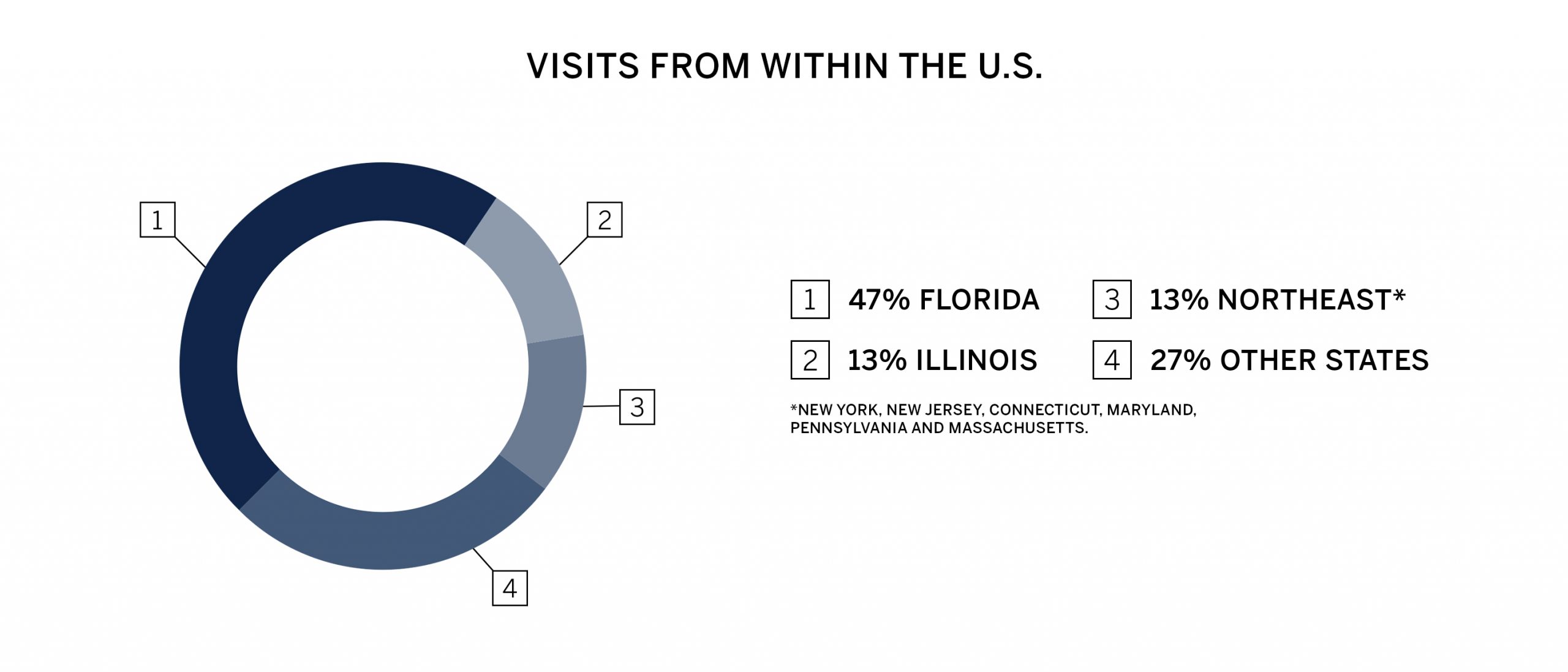
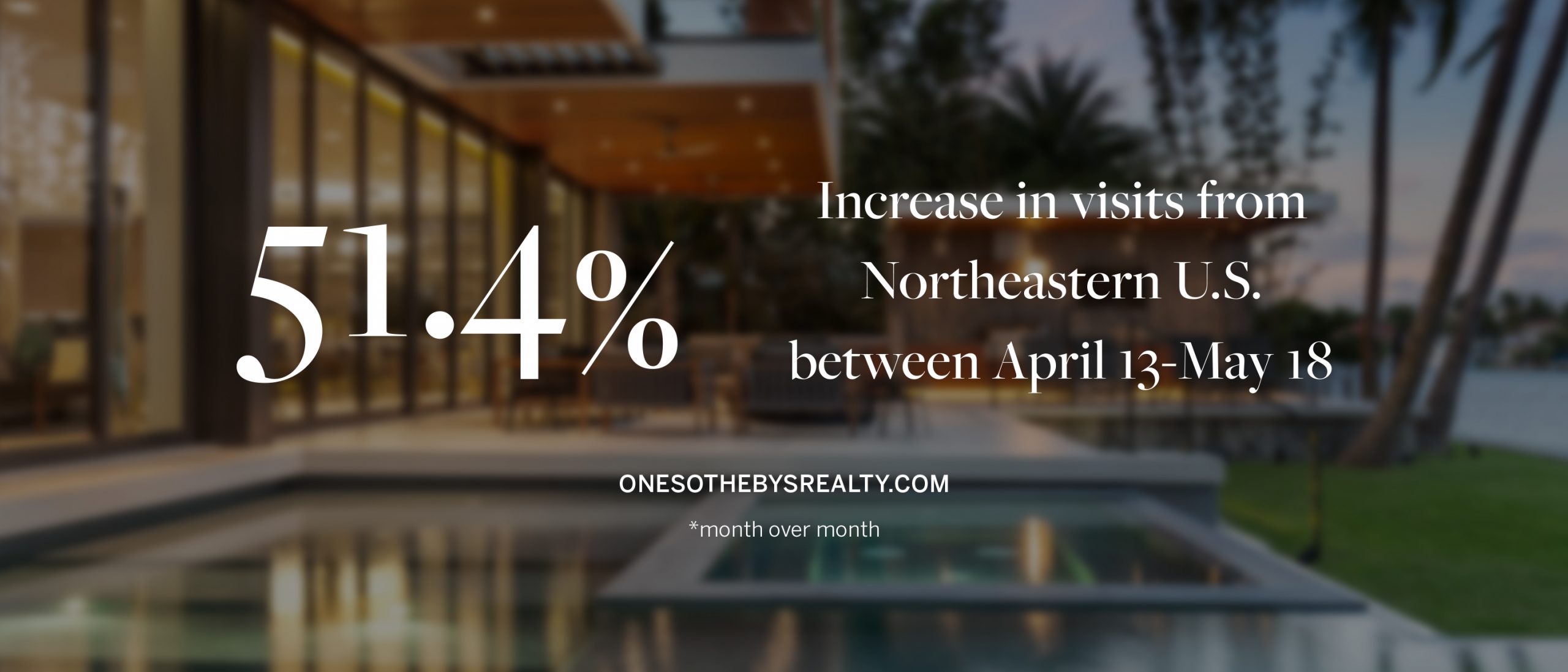
Indeed, it isnt merely this increase in west coast buyers that is the only factor contributing to Florida as a top destination in the nation. The unparalleled lifestyle and great economic value have both attracted a new group of primary home buyers, where once Southeast Florida was identified purely as the second home capital of the world. Specifically, retirees and active professionals looking to experience this flawless state are flocking down south to permanently relocate. This new migration was spurred substantially increased real estate growth statewide.
Retirees: Empty Nesters & High-Net-Worth Individuals: As new home buyers reach the stage in their life when the children leave the nest, no destination is more ideal than Florida. The definition of calm, Floridas tranquil landscape, warm, and gracious southern spirit is the epitome of hospitality.
With over 65 million baby boomers in the U.S. reaching the age of retirement, making long term decisions regarding where they should live, Florida is in the spotlight as the prime destination. Its charming beauty is undeniable. But its lush surroundings are not the only reason why baby boomers continue to invest in the state. Empty nesters and those retaining competitive financial portfolios are attracted to Floridas economic opportunity and picturesque lifestyle.
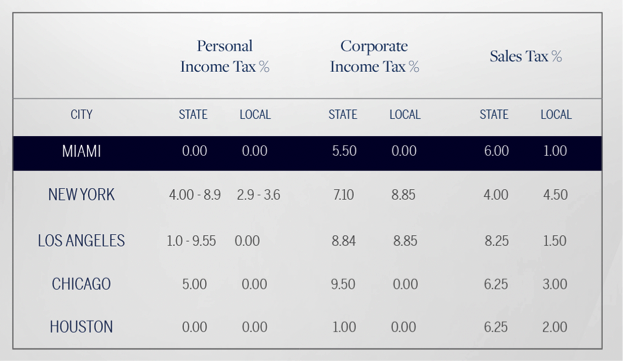
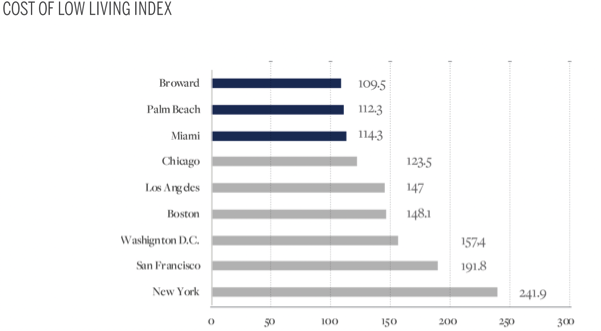
Economic Opportunity: Floridas most vital asset is its tax advantages. In the U.S., there are three levels of taxation on personal income and this includes federal, state and city taxes. In Florida, only federal taxes are imposed on personal income removing a key tax burden. If we combine a low tax environment with a relatively low cost of living, individuals can maximize their disposable income. This is part of Floridas recipe for success. This highlights a strong value proposition making Floridas coastal community even more alluring to potential buyers.
Unparalleled Lifestyle: More than a serene setting, Florida enjoys an average temperature of 72 degrees. Here, residents can experience sand, surf, and endless summer year-round. The lifestyle of Floridians involves far more than the sun and the sea, however.
Florida is a mecca of open-air shopping malls, magnificent marina slips, championship tennis courts, and pristine golf courses. South Floridas art and cultural offerings have expanded dramatically with the arrival of Art Basel Miami Beach (2002), Adrianne Arsht Center (2006), Miami New Symphony (2011), and Prez Art Museum Miami (2016). In addition, high-end culinary dining options have exploded. Since 2008, Miami has grown into a critically acclaimed gastronomic scene with over 200 new restaurants helmed by internationally recognized cefs.
Florida is also home to championship professional sports teams, including: the Miami Heat, Florida Panthers, Miami Dolphins, and Miami Marlins. The PGA Tournament (Golf) and Miami Open (Tennis) take place annually, along with other golf and tennis tournaments. In the near future, sport and entertainment options will continue to thrive in South Florida with the arrival of F1 and the MLS team to Miami.
Active Professionals: Millennials: Second to the Baby Boomer population, Millennials (identified as ages 36 and younger) account for the largest portion of homebuyers: equaling 34% in South Florida.Different from retirees, this growing population is less attached to possessions and locations and instead value vibrant experiences and independence. With the Covid-19 pandemic forcing Americans to work from home, its predicted that Florida will attract this eager demographic amid the viruss aftermath. This is due to Floridas cost of living, tax advantages, affordable housing options with attractive amenities, and incomparable lifestyle. Its the next gens ideal destination.
Nevertheless, Covid-19 has still forced professionals into unemployment due to South Floridas large hospitality, retail, and travel industries. Prior to the pandemic, the unemployment rate in Miami was 3%, while the states total unemployment rate was 3.4% and the national unemployment rate was at 3.6%.
In the long-term, however, the recovery will be driven by a new wave of young people relocating to the state. This will increase demand for real estate, while new development supply and resale inventory has decreased significantly. These positive underlying factors lead to a favorable forecast for 2021. Millennial buyers should take advantage of the current situation and acquire valuable long-term real estate assets. In the next five years, real estate will be on an upswing with strong appreciation in value. This is due to the fact that waterfront land availability in metropolitan areas is becoming limited, triggering value appreciation due to the scarcity value.
Outside of Floridas burgeoning real estate market, the next gen population is looking to Florida for its strong economy. Here, millennials can experience a rapidly developing state with an influx in worldwide corporations, venture capitalist firms, financial headquarters, and above all a geopolitical capital.
 Strong Economy: As Florida strengthens its economy, especially in South East Florida, largescale companies are continuing to relocate their headquarters to the state. U.S. companies are building Latin America and Caribbean headquarters, European companies are choosing South Florida to tap into the Americas and Latin American corporations are entering the U.S. from South Florida and Miami due to its strong position in the hospitality sector. This has driven Miamis reputation as one of the most cosmopolitan cities in the country with 51% of the total population wasnt not native to Miami. This diversity factor has led to a refreshing splash of culture to the region.
Floridas attractive tax structure is what ultimately drives its economy, made for corporations, professional bilingual work force, affordable office spaces, and modern logistical hubs, including: airports, ports, railroad systems, and highway infrastructures. The geopolitical location of Miami and the frequency of flights to all metropolitan cities in the U.S., and most international capitals, makes this metropolis appealing to companies for global business.
Prime Financial Center: Today, Miami is the second largest financial center in the U.S., with over 100 international banks, and trade offices. Spurred by this positive development, the economy has incorporated higher paying salary industries in the areas of health, wealth management, private equity, technology, aviation, and real estate.
This was not always the case. During the mid-1930s, as Florida transformed from uninhabited swaths of land to a balmy tropical destination, an increase of tourism surged job creation. However, agriculture and tourism are typically lower salary industries. It wasnt until the 1980s that Miamis banking industry robustly grew.
Decades later, Miami is a replete with international trade offices, consulates, private equity firms, and banks. Uniquely contributing to this growth is NAP of the Americasthe internet hub for LATAMheadquartered in Downtown Miami. Miami now ranks as one of the top five cities in the world in terms of internet speed. This is crucial for the tech industry. Increasingly more startups are relocating to South Florida, including Venture Capitalist firms coining Miami as Billionaire Beach. Some of the most active players in the industry include Jeff Ransdell of Rokk3r Fuel, Melissa Krinzman of Krillion Ventures, and Ana Gonzalez of 500 Startups.
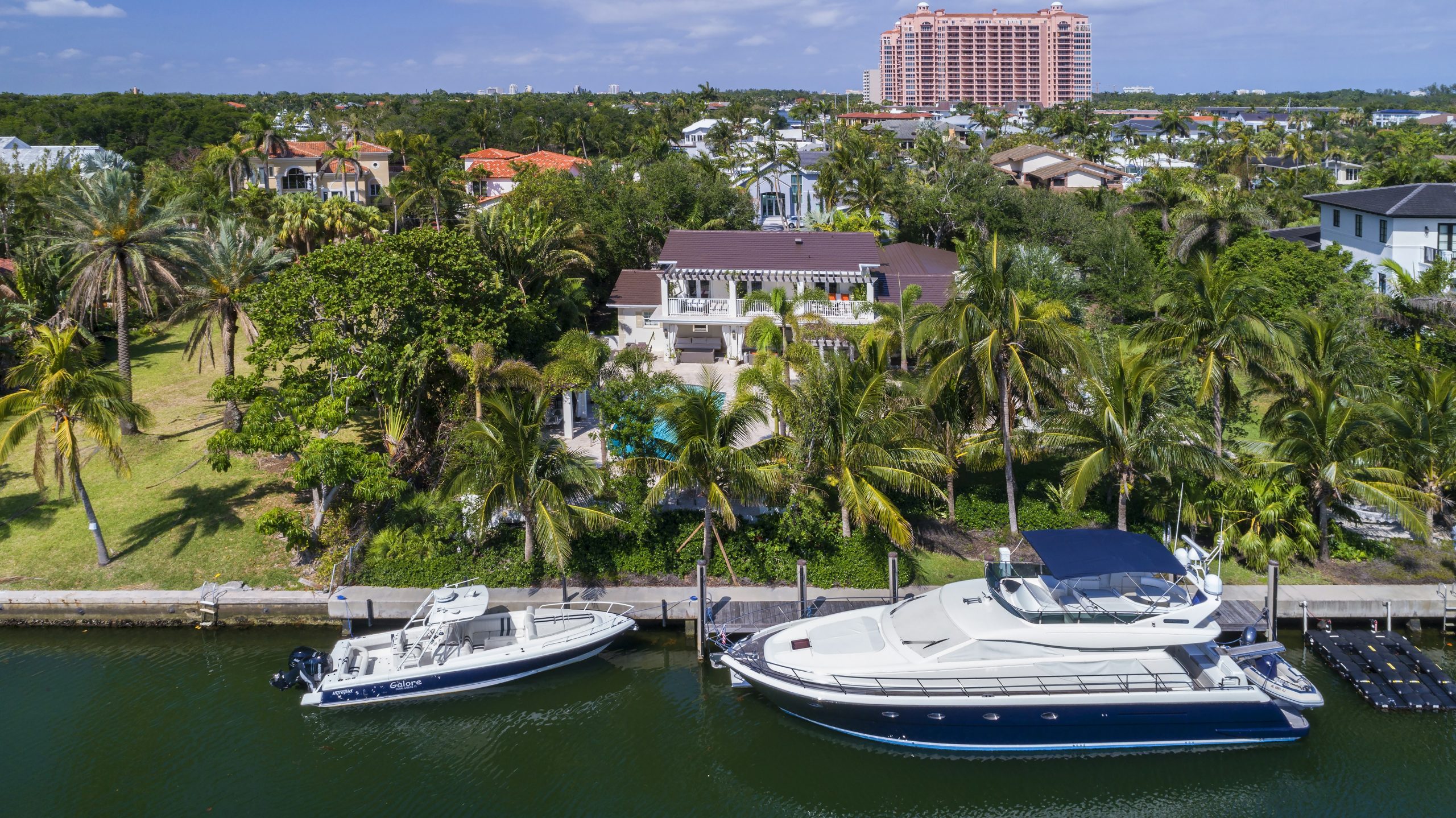 6945 Sunrise Terrace, Coral Gables. Exclusively Listed by Jorge Uribe
 6945 Sunrise Terrace, Coral Gables. Exclusively Listed by Jorge Uribe
The Trend Is Here to Stay: Florida Attracts Buyers from Outside The U.S.: Its not only Americans that find Florida to be undeniably appealing. Buyers outside the country recognize it, as well. With this additional increase in buyers, a new category of property owners is on the rise including primary home buyers (people relocating to Florida), second home buyers (people interested in Floridas lifestyle), and investors (people looking for a safe-haven, hard currency income, capital appreciation and diversification of their asset base). Unfortunately, as this new category was on a steep incline, COVID-19 and its travel restrictions caused a decrease in international demand. This is also largely due to the decline in dollar appreciation vis--vis local currencies in key feeder markets. Were experiencing a slowdown. In counterpoint, this slowdown is encouraging a demand that will push buyers from outside the U.S. to Florida in the future. The trend is here to stay.
The reasons for why Florida is constantly attracting buyers outside the country is similar to American demand. These major factors include economic, job opportunist, entrepreneurship, and lifestyle. In contrast from Americans, it is important to understand why international buyers leave their home countries behind and relocate to the U.S. Some of the main considerations include the economy (Brazil, Mexico and Argentina), uncertain political environments (Venezuela, Mexico and Argentina), increase in social unrest (Chile, Ecuador, Peru and Nicaragua), and rise in crime and violence. These are the main roots. This is especially true for HNWI, where in some cases they continue to own and operate their businesses in their home countries, while relocating their families to America.
Additionally, the healthcare system in the U.S. is a deciding factor for retirees, with a vast number of world-class hospitals and specialized doctors being located in Florida. With top-ranked schools and research institutions located throughout the state, education has also become an important deciding factor for working professionals and business owners. The upcoming direct flights from Asia will also propel further relocations to Florida, specifically based on quality education at a more affordable cost in comparison to other states that attract Asian buyers. These states include California and New York. Overall, buyers outside of the country will continue to look to Florida as a magnet for real estate and economic opportunity.
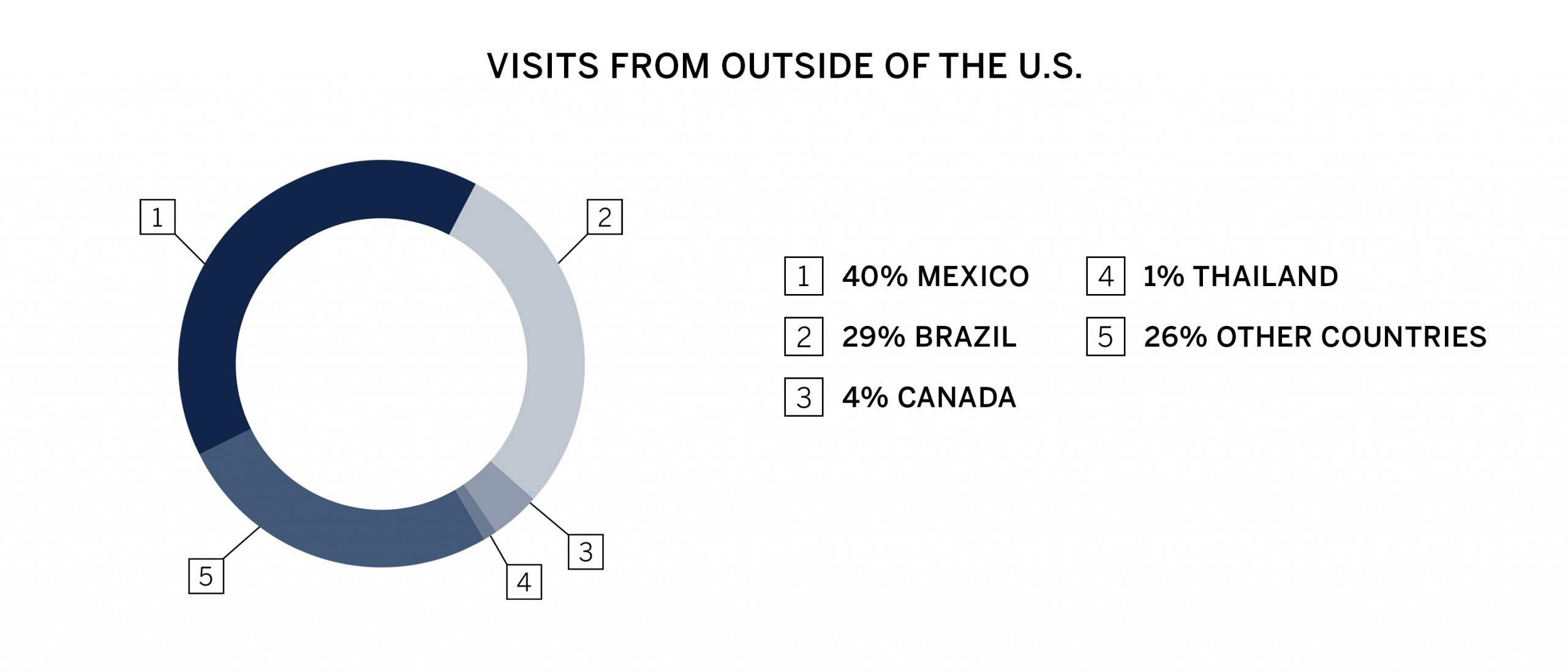
International buyers to date by ranking is as followed:
Historically, Canada is th top source of international buyers in Florida, followed by the UK (Central Florida), Brazil, Argentina, and Venezuela. Today, buyers from Mexico have been more active in the state, ranking #5 in the U.S. with 2.3 billion purchases in 2019. This trend is also reflected on the www.onesothebysrealty.com website. Here, Mexico represented 40% of the international digital footprint.
A Bright Outlook on The Real Estate Market In Florida
In the last decade, Florida has been named the #1 state in the U.S. for relocations. And this trend is here to stay. This positive outlook on the real estate market, retirees, millennials, and buyers outside the country will result in continued relocation to Florida due to its signature lifestyle, strong value, and growing economy. With the impact of COVID-19 encouraging buyers to reassess where they live, Florida has been brought into the spotlight with its beaches, parks, favorable weather, low-taxes, low cost of living, less dense urban centers, and less dense household options. In addition, changes in corporate behavior (collaborative technology, communication platforms, offices location, offices layouts, flexible working options) will further attract buyers to Florida.
Looking to the future, the following years will be pivotal in Floridas growth welcoming a new wave of buyers, locally and internationally. A demand for real estate will be on a steep climb as the economy strengthens and Floridas unmatched lifestyle becomes increases its appeal. To close, the future is bright, and the possibilities are endless for Floridas real estate industry.
Connect with Fernando on LinkedIn and Instagramor e-mail: fdn@onesothebysrealty.com

Socials